
services
Near Field Radar Applications
Seeing the Unseen at Close Range

Near-Field Radar Applications: Custom Integration from Concept to SOP
Getting a radar sensor to detect an object is only the beginning.
Getting it to perform reliably inside a real product is where the real engineering starts.
Moving from an evaluation board to Start of Production (SOP) introduces challenges that hardware alone cannot solve. Digital signal processing, frequency selection, radome design, embedded software, and system integration all determine whether a promising prototype becomes a reliable product or another delayed project.
HALready bridges that implementation gap.
From concept validation and custom PCB design to embedded software, algorithm development, and production-ready integration, we help engineering teams turn near-field radar concepts into products that are ready for the real world.
The result is simple: lower development risk, faster Time-to-Market, and a clearer path to SOP backed by high-velocity engineering and German engineering quality.
Planning a near-field radar project?
Contact HALready or book a Free Product Sparring Session to review your architecture and discuss the fastest path to production.
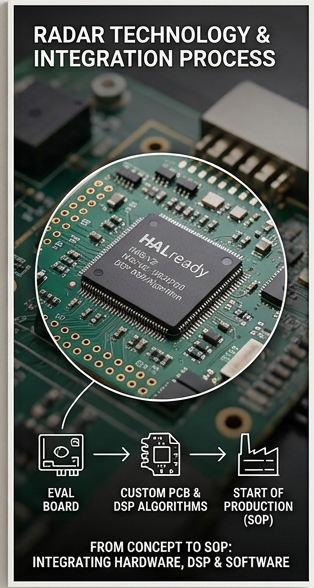
The Implementation Gap: Why Off-the-Shelf Radar Modules Fail
Evaluation boards from vendors such as NXP and Infineon are excellent for proving that a radar sensor works.
They are not designed to prove your product will.
This is where many radar projects slow down.
The hardware captures data, but turning that data into reliable object detection requires far more than connecting a sensor to a processor. Point-cloud processing, Digital Signal Processing (DSP), filtering false positives, middleware, and embedded software quickly become the real engineering challenge.
A prototype that performs well in the lab may struggle in production because the software cannot reliably distinguish between meaningful signals and environmental noise. False positives increase. Algorithms become more complex. Development slows as engineering teams spend more time debugging middleware than building new features.
Every new hardware revision, sensor configuration, or operating environment introduces new variables into the processing pipeline. As projects become more complex, the radar hardware is rarely the biggest challenge. The real bottleneck is building a software stack that consistently transforms raw point-cloud data into reliable, real-time decisions without increasing latency or creating new sources of error.
Moving from an evaluation board to a production-ready device also means designing a custom PCB, selecting the right frequency, integrating the full software stack, and ensuring the radar performs reliably inside its final enclosure.
This is the point where most radar integrations succeed or fail.
HALready helps engineering teams bridge the gap between radar hardware and production-ready embedded systems by combining embedded hardware, software, DSP, and system integration into one engineering workflow. Instead of treating each challenge separately, we build the complete radar solution with production, scalability, and Time-to-Market in mind.
Struggling to move beyond the evaluation board?
Book a Free Product Sparring Session and review your radar architecture with HALready’s engineering team before small integration issues become costly production delays.
Core Near-Field Radar Technologies
Choosing the right radar technology is about more than frequency. The sensing principle directly affects range resolution, object classification, accuracy, and the complexity of the software stack that follows.
FMCW vs. CW vs. Pulsed Radar
Continuous Wave (CW) radar is well suited for measuring motion and velocity, but it cannot determine distance on its own.
Frequency-Modulated Continuous Wave (FMCW) radar measures both range and velocity by transmitting continuously changing frequencies. Its higher range resolution makes it especially valuable for applications such as occupancy sensing, industrial positioning, and vital sign monitoring where small differences in distance matter.
Pulsed radar takes a different approach. It transmits short radar pulses and uses the time between transmission and the reflected signal to determine distance. This makes it particularly useful when precise ranging is the primary requirement.
For example, Acconeer’s XM125 module uses the 60 GHz A121 Pulsed Coherent Radar (PCR) sensor, which supports high-precision distance measurement with an absolute range of up to 20 meters. The actual measurable distance depends on factors such as the object’s size, shape, and dielectric properties.
The right radar architecture depends on what the product needs to measure, the required accuracy, operating environment, power constraints, and processing requirements.
Micro-Doppler Sensing & Point-Cloud Data
Detecting an object is only part of the challenge. Understanding what the object is requires more advanced signal processing.
Micro-Doppler analysis captures subtle movement patterns, such as breathing, hand gestures, or rotating components, while point-cloud data provides a spatial representation of the environment.
Together, they enable more accurate object classification and reduce false positives. The quality of object classification depends not only on the radar hardware, but also on how the DSP pipeline interprets these reflections under changing environmental conditions.
The challenge lies in the Digital Signal Processing (DSP) algorithms that transform raw radar reflections into reliable, real-time decisions.
High-Value Industry Applications for Near-Field Radar
Near-field radar is being adopted across industries where conventional sensors struggle with reliability, lighting conditions, privacy, or environmental interference. The challenge is rarely detecting an object. It is extracting accurate, real-time information that the product can trust.
Healthcare & Vital Sign Monitoring
Near-field radar can measure heart rate, breathing patterns, and lung respiratory volume from distances of around upto 7 meters, without requiring wearables or direct patient contact.
The challenge lies in detecting tiny chest movements while filtering out body motion, environmental interference, and signal noise. Accurate vital sign monitoring depends on advanced Micro-Doppler analysis and Digital Signal Processing (DSP), not just the radar sensor itself.
Small differences in breathing patterns, body movement, or surrounding interference can affect signal quality. Reliable monitoring depends on algorithms that separate physiological signals from environmental noise without compromising accuracy.
Smart Factory & Industrial Automation
Industrial environments demand sensing systems that respond accurately in real time.
Near-field radar supports applications such as collision avoidance, precise thickness measurement, object positioning, and machine monitoring. Achieving reliable performance requires robust signal processing that can distinguish meaningful reflections from machinery, vibration, and other sources of interference.
Many industrial environments also introduce metallic structures, moving equipment, dust, and changing operating conditions. Reliable radar performance depends on filtering these variables while maintaining consistent object detection in real time.
Smart Home & Ambient Assisted Living (AAL)
In smart homes, the goal is understanding human presence rather than simply detecting movement.
Near-field radar enables presence detection, fall detection, and occupancy monitoring, even when visibility is limited or non-conductive materials separate the sensor from the user. Reliable performance depends on choosing the right frequency, minimizing material attenuation, and developing algorithms that reduce false positives while maintaining user privacy.
Unlike camera-based systems, radar provides continuous sensing without capturing identifiable images, making it well suited for privacy-sensitive residential and assisted living environments.
Exploring a new radar application?
Book a Free Product Sparring Session to discuss your use case with HALready’s engineering team.
The HALready Approach: Mastering the Full Radar Stack
Successful radar products are built by solving the challenges between the sensor and the final product. HALready supports the complete radar stack, from hardware decisions and embedded software to signal processing and production-ready integration.

Frequency Selection & ISM Band Compliance
Choosing between 24GHz, 60GHz, and 120GHz is not simply a hardware decision. Each frequency offers different trade-offs in range, resolution, penetration, and environmental performance.
HALready helps teams select the right frequency based on application requirements while considering ETSI, FCC, and ISM band regulations. The right choice depends on sensing distance, target size, environmental conditions, penetration requirements, and processing complexity.
Selecting the appropriate frequency early helps reduce redesign work and supports smoother regulatory compliance later in development. The goal is to build a radar system that performs reliably and meets regional compliance requirements from the start.
Digital Signal Processing (DSP) & Algorithm Development
The radar chip captures reflections. The algorithm decides what they mean.
Reliable radar performance depends on distinguishing meaningful reflections from background noise, clutter, and environmental interference. That is where robust DSP algorithms make the difference between inconsistent detections and dependable sensing.
HALready develops Digital Signal Processing (DSP) pipelines and algorithms that filter noise, reduce false positives, process point-cloud data, and improve object classification in real time.
The result is radar software that delivers reliable data instead of overwhelming the application with unnecessary complexity.
Frequency Selection & ISM Band Compliance
Choosing between 24GHz, 60GHz, and 120GHz is not simply a hardware decision. Each frequency offers different trade-offs in range, resolution, penetration, and environmental performance.
HALready helps teams select the right frequency based on application requirements while considering ETSI, FCC, and ISM band regulations. The right choice depends on sensing distance, target size, environmental conditions, penetration requirements, and processing complexity.
Selecting the appropriate frequency early helps reduce redesign work and supports smoother regulatory compliance later in development. The goal is to build a radar system that performs reliably and meets regional compliance requirements from the start.
Digital Signal Processing (DSP) & Algorithm Development
The radar chip captures reflections. The algorithm decides what they mean.
Reliable radar performance depends on distinguishing meaningful reflections from background noise, clutter, and environmental interference. That is where robust DSP algorithms make the difference between inconsistent detections and dependable sensing.
HALready develops Digital Signal Processing (DSP) pipelines and algorithms that filter noise, reduce false positives, process point-cloud data, and improve object classification in real time.
The result is radar software that delivers reliable data instead of overwhelming the application with unnecessary complexity.
Radome Design & Material Attenuation
Even a well-designed radar system can lose performance once it is placed inside its enclosure.
The radome material, thickness, shape, and mounting position all influence signal attenuation and detection accuracy. Even small changes to enclosure geometry or material selection can alter signal propagation and reduce sensing performance.
Considering these effects early helps avoid expensive redesigns during validation and production. A housing that looks ideal mechanically can significantly reduce radar performance if these effects are ignored.
HALready considers radome behaviour as part of the engineering process, helping teams balance industrial design, manufacturability, and sensing performance before problems appear during validation.
Need a second opinion on your radar architecture?
Contact HALready or book a Free Product Sparring Session to review your design before integration challenges delay your project.
Accelerating Your Radar Project to Start of Production (SOP)
Whether your project is still at the concept stage or already facing integration challenges, the next step is the same: gain technical clarity before investing more time and budget.
HALready starts every engagement with a Free Product Sparring Session. It is a focused technical discussion designed to understand your application, identify the biggest engineering risks, and define the fastest path toward Start of Production (SOP).
During the session, we can help you assess:
- The technical feasibility of your radar concept
- Architecture and integration challenges
- Frequency selection and compliance considerations
- DSP, algorithm, or software bottlenecks
- The engineering effort, timeline, and next steps
The goal is not to sell a predefined solution. It is to give your team a clear technical direction based on your product requirements, engineering risks, and timeline.
With HALready, you work directly with experienced embedded engineers through bi-weekly reporting, proactive transparency, and clear technical milestones. You always know what is being built, what risks have been identified, and what happens next.
The objective is simple: reduce uncertainty, accelerate development, and keep your project moving toward SOP.
Ready to move beyond prototypes?
Contact HALready or book your Free Product Sparring Session to review your radar architecture and discuss the fastest path to production.
Frequently Asked Questions
Does near-field radar work through walls or other materials?
Near-field radar can detect objects through many non-conductive materials such as plastic, glass, drywall, and textiles. Performance depends on the radar frequency, material properties, thickness, and radome design. Selecting the right hardware and developing the correct signal processing algorithms are essential for reliable detection.
Do I need a license to operate a 60GHz radar sensor?
In many regions, including Europe, 60GHz radar can operate within designated ISM bands without an individual license, provided the system complies with applicable regulations such as ETSI standards. Compliance requirements vary by frequency, output power, and application, so they should be considered early in the design process.
What is the difference between radar presence detection and PIR sensors?
PIR sensors detect changes in infrared radiation and generally require movement to trigger detection. Near-field radar can detect presence through subtle motion, such as breathing or small body movements, making it better suited for occupancy sensing, vital sign monitoring, and Ambient Assisted Living (AAL) applications.
Can HALready help rescue an existing radar project?
Yes. HALready supports projects at every stage, from concept validation to production integration. Whether the challenge involves DSP algorithms, false positives, embedded software, custom PCB design, radome performance, or system integration, we help identify the root cause and define the fastest path forward.
How do I get started with HALready?
The best place to start is a Free Product Sparring Session. We’ll review your application, discuss your current architecture, identify technical risks, and recommend practical next steps for moving your radar project toward Start of Production (SOP).
Is HALready the right fit for your company?
HALready is ideal for companies without in-house embedded system expertise or with development bottlenecks. We help you move fast without sacrificing quality.
Is HALready the right fit for your company?
HALready is ideal for companies without in-house embedded system expertise or with development bottlenecks. We help you move fast without sacrificing quality.
Is HALready the right fit for your company?
HALready is ideal for companies without in-house embedded system expertise or with development bottlenecks. We help you move fast without sacrificing quality.
Is HALready the right fit for your company?
HALready is ideal for companies without in-house embedded system expertise or with development bottlenecks. We help you move fast without sacrificing quality.
Is HALready the right fit for your company?
HALready is ideal for companies without in-house embedded system expertise or with development bottlenecks. We help you move fast without sacrificing quality.
Is HALready the right fit for your company?
HALready is ideal for companies without in-house embedded system expertise or with development bottlenecks. We help you move fast without sacrificing quality.
Is HALready the right fit for your company?
HALready is ideal for companies without in-house embedded system expertise or with development bottlenecks. We help you move fast without sacrificing quality.
Is HALready the right fit for your company?
HALready is ideal for companies without in-house embedded system expertise or with development bottlenecks. We help you move fast without sacrificing quality.
Is HALready the right fit for your company?
HALready is ideal for companies without in-house embedded system expertise or with development bottlenecks. We help you move fast without sacrificing quality.
Is HALready the right fit for your company?
HALready is ideal for companies without in-house embedded system expertise or with development bottlenecks. We help you move fast without sacrificing quality.
Is HALready the right fit for your company?
HALready is ideal for companies without in-house embedded system expertise or with development bottlenecks. We help you move fast without sacrificing quality.
Is HALready the right fit for your company?
HALready is ideal for companies without in-house embedded system expertise or with development bottlenecks. We help you move fast without sacrificing quality.
Is HALready the right fit for your company?
HALready is ideal for companies without in-house embedded system expertise or with development bottlenecks. We help you move fast without sacrificing quality.
Is HALready the right fit for your company?
HALready is ideal for companies without in-house embedded system expertise or with development bottlenecks. We help you move fast without sacrificing quality.
Is HALready the right fit for your company?
HALready is ideal for companies without in-house embedded system expertise or with development bottlenecks. We help you move fast without sacrificing quality.
Is HALready the right fit for your company?
HALready is ideal for companies without in-house embedded system expertise or with development bottlenecks. We help you move fast without sacrificing quality.
Is HALready the right fit for your company?
HALready is ideal for companies without in-house embedded system expertise or with development bottlenecks. We help you move fast without sacrificing quality.
Is HALready the right fit for your company?
HALready is ideal for companies without in-house embedded system expertise or with development bottlenecks. We help you move fast without sacrificing quality.
Is HALready the right fit for your company?
HALready is ideal for companies without in-house embedded system expertise or with development bottlenecks. We help you move fast without sacrificing quality.
Is HALready the right fit for your company?
HALready is ideal for companies without in-house embedded system expertise or with development bottlenecks. We help you move fast without sacrificing quality.
Still have questions?
Contact HALready or book your Free Product Sparring Session to discuss your project with our engineering team.